

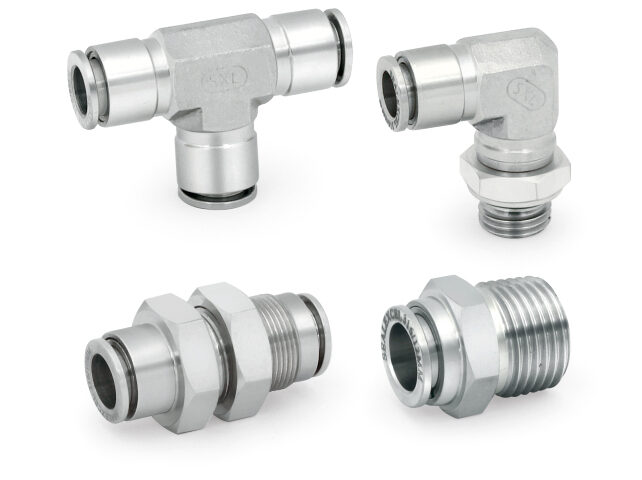
Push-fit accessories let plant teams build and change compressed air lines without tape, torque, or threading. The collet grips while an O-ring seals, so joint integrity depends heavily on tube cut quality, routing, and temperature. Used within their pressure and media limits, they reduce leak points across a line.
Key Takeaways
- Push-fit fittings separate the gripping job from the sealing job inside one body.
- A square, burr-free tube cut is what makes the O-ring seal properly.
- Long nylon runs need slack so tube movement does not pull out of shallow ports.
- Cut back about 10 mm of tube before refitting a connection you’ve released.
- Plastic push-fit suits air, water and vacuum service, not hydraulic pressure or steam.
Plant layouts change more often than the drawings suggest. A machine gets moved, a workstation is added, and the air line that fed it yesterday now runs to the wrong place. Threaded joints make that kind of rework slow. Every joint has to be cut, sealed, wrenched, and then tested again before the line goes back into service.
This is where push-fit air & pneumatic accessories earn their place. The tube pushes into the port, a collet and an O-ring hold it, and the joint seals without tape or torque. Fitters connect cylinders, manifolds, silencers, and flow regulators in seconds. A branch line that once took most of a shift to re-route can be finished before lunch.
How a Push-Fit Fitting Holds Pressure
The grip and the seal are two separate jobs inside one body. Stainless steel teeth in the collet bite the tube’s outer wall and resist pull-out. An elastomer O-ring sits deeper in the port and seals. Air pressure pushes the tube outward slightly, tightening the collet grip rather than loosening it.
Tube Preparation Decides Whether the Seal Holds
Cut quality matters more than most people expect. A tube trimmed with side cutters goes out of round, and that tube ovality leaves a gap the O-ring cannot close. A square, burr-free end from a proper tube cutter seals first time. Scratches along the tube wall also cause slow leaks, since the O-ring seals against that surface.
Temperature and Tube Routing Limits
Most push-fit bodies use acetal or nylon with a nitrile seal, and those materials soften as service temperature climbs. Thermal expansion in long nylon runs also pulls the tube out of shallow ports when the line is clipped tight. A gentle bend in each run absorbs that movement and keeps the load off the fitting.
Disconnection and Reuse During Maintenance
Push-fit accessories release by pressing the collet ring and drawing the tube out. That makes filter changes and valve swaps quick. The tube end takes a set of small tooth marks each time, so cut back about 10 mm before refitting to give the collet fresh material to bite into and restore the original holding force.
Where Push-Fit Suits the Job and Where It Does Not
- Compressed air service at moderate pressure, commonly up to 10 bar (145 psi) with plastic tube.
- Water and coolant lines, provided the seal material matches the fluid.
- Vacuum lines, where push-fit designs hold down to low absolute pressures.
- Stainless steel push-in fittings for washdown areas, food production, and marine decks.
- Not suited to hydraulic pressure, live steam, or media that attack the seal compound.
Fewer Joints to Chase, Fewer Leaks to Find
Compressed air leaks cost money every hour the compressor runs, and most of that loss starts at connections rather than in the pipe itself. Push-fit accessories cut down the number of places a fitter can get a joint wrong.