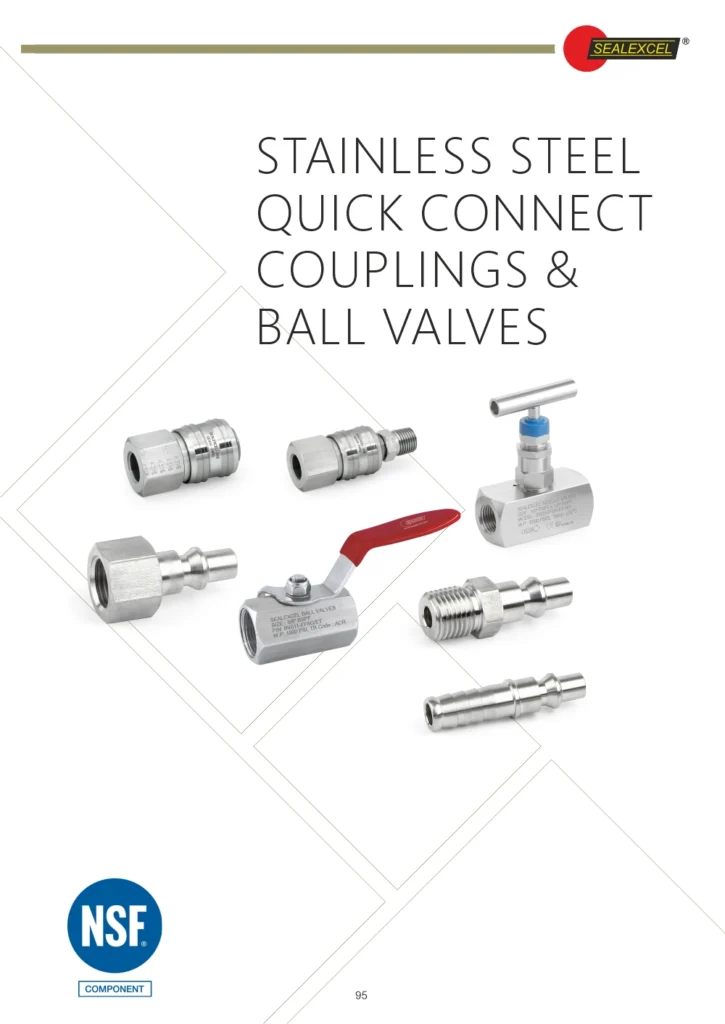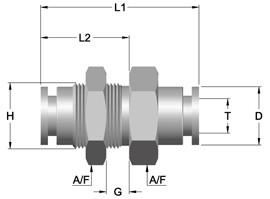


Leaks and pressure loss start at the connection points, not the compressor. Top pneumatic companies in India build their reputation on fitting accuracy, correct material choice and sealing that survives millions of cycles.
Key Takeaways
- Most air loss in a plant starts at fittings, not at the compressor.
- Top pneumatic companies in India win work on machining accuracy and sealing life.
- Brass or stainless steel. The line decides, not the price list.
- Helium leak testing catches what soap bubbles never will.
- Dimensional match with installed fittings keeps a retrofit short.
Most compressed air problems start at a joint, not at the compressor. Engineers weighing up the top pneumatic companies in India spend their time on cylinder bore, stroke length and valve response. Fittings get a page in the catalogue and little else. Plants pay for that gap every shift, and the cost never lands on a single line item.
One push-in fitting weeping at 6 bar sounds like nothing. Two hundred of them, and the compressor is running an extra hour a day to stand still. Top pneumatic companies in India put real design effort into that joint. It carries the whole circuit. Machining accuracy there decides how the rest of the system behaves.
The Leaks Nobody Puts on a Work Order
- Air Loss that Hides in Plain Sight: A 3 mm hole at 7 bar, near enough 100 psi, pulls compressor power all day and never trips an alarm. Few plants have one. Most have forty, sitting in manifolds, elbows and quick connect couplings that were fitted once and forgotten. Nobody hears it over the machines.
- Pressure Drop with the Wrong Culprit: Narrow bores and rough internal surfaces choke flow well upstream of the actuator. Cylinder slows. Cycle time creeps. The maintenance team strips the cylinder, fits new seals, finds nothing, and the restriction is still sitting in an elbow three metres back. The fitting almost never gets blamed for any of it.
Precision at the Joint Decides Plant Uptime
- Tolerances that Hold under Cycling: A pneumatic circuit cycles millions of times before anyone thinks about it again. Loose tolerance seals fine on day one, then starts weeping around month six. Steady bore diameters and controlled ferrule geometry hold the seal through vibration, heat swing and repeated pressure spikes. Machining shows up years later.
- Materials Matched to the Line: Brass copes with general shop air. Anywhere near a marine deck or a washdown area, chloride finds it inside a season. Food, offshore and pharmaceutical lines want 316 or 316L stainless steel. Choosing that grade on price alone shows up later as contamination. The line dictates the material.
What Sharp Buyers Check before Signing Off
- Compatibility with What Is Already Installed: Most plants run fittings from one or two established systems already. A part that does not interchange dimensionally means rebuilding the whole run. Matching the installed tube fittings keeps the shutdown short, and shutdown hours cost far more than the fittings ever will. Procurement finds this out late.
- Thread standards spelled out on the datasheet, covering NPT, BSPT and BSPP.
- Working pressure given in bar and psi, with the burst margin alongside it.
- Test evidence. Helium leak detection turns a claim into a measurement.
- Certification traceable to the actual grade, not a vague stainless label.
- Size coverage from 3 mm through 25 mm, so one supplier handles the whole job.
- Paperwork that Stands Up to an Auditor: Pharmaceutical and food plants need the file as much as the hardware. Approvals published openly are one reason the top pneumatic companies in India get onto approved vendor lists, with ISO 9001:2015 certification sitting behind product specifications such as ASTM F1387-99 and MSS SP-99. An auditor asks. The file answers.
In-house Testing Turns Claims into Evidence
- Helium Leak Detection under Real Load: Soap bubbles catch the obvious failures. The slow bleed that empties a receiver overnight goes straight past them. Helium leak detection picks up leakage far below anything an operator could hear, which is why vacuum work and high-purity lines insist on it. Cheap test. Expensive omission.
- Burst Data Beats Catalogue Confidence: Hydrostatic burst testing shows the point where a fitting actually lets go. Design engineers set their safety factors against that number rather than against a printed estimate they cannot verify. Without the test behind it, a working pressure figure on a specification sheet is an estimate and nothing more.
Systems that Hold Pressure Long after Handover
Whether a circuit still holds pressure in its fifth year comes down to parts most people never look at twice. Fittings deserve the scrutiny given to cylinders. Anyone specifying a new line, or replacing a leaking one, should ask a manufacturer for material certificates, burst data and dimensional drawings before the order goes out.